You Can (and Probably Should) Reduce Toil Even if you Hate AI
This message is for those that do not like working with AI: You should use it anyway.
There are 2 possible outcomes:
- It doesn’t work. You use AI and you still do not like working with it. Your underlying opinion hasn’t changed but you now have concrete examples and you can articulate a specific reason why you don’t like it (should you choose to share your opinion).
Ex: “I asked Claude Code to help me review my Jira list for the week. It should be a simple task but it failed. I even used Opus X.Y. It burned 15% of my API usage and still managed to miss certain tickets. It picked up stories, but not tasks.”
- It works. You use AI and find that it is capable of completing the tasks you have requested. Your underlying opinion begins to change and you can articulate what has improved (should you choose to share your opinion).
Ex: “I asked Claude Code to help me review my Jira list for the week. I don’t trust it with significant work, but I’ve found it is at least capable of automating simple stuff which allows me more time to focus on higher value work.”
There will be increasing pressure to adopt AI. Regardless of your position, you’ll want to articulate your reasons, just as you probably expect others to do when they take a position.
Start small and reduce toil first
You don’t have to invest heavily, just get rid of something small that you hate doing. These tasks are simple to define and validate. Then reinvest whatever time is saved into the next easiest to automate task. Repeat.
If nothing else, you will gain a better understanding of AI capabilities. Success at each stage reduces toil and gives you more time to focus on more meaningful work. When it breaks, you know the upper limit where it tends to fail.
But what if you spend more time automating than it takes to do it manually?
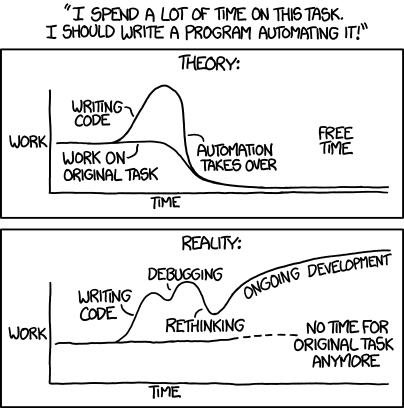 Source: xkcd #1319: Automation by Randall Munroe.
It has always been a possibility. It isn’t just an AI thing. At least you’re starting small. Even when this happens, you’ll learn new skills or form meaningful technical opinions.
More likely, you’ll enjoy time saved on specific tasks until it fails, and then you’ll gain understanding of model limitations. You win either way.
The grid below is still true, but I’m willing to bet you’ll find an automation candidate that pays off.
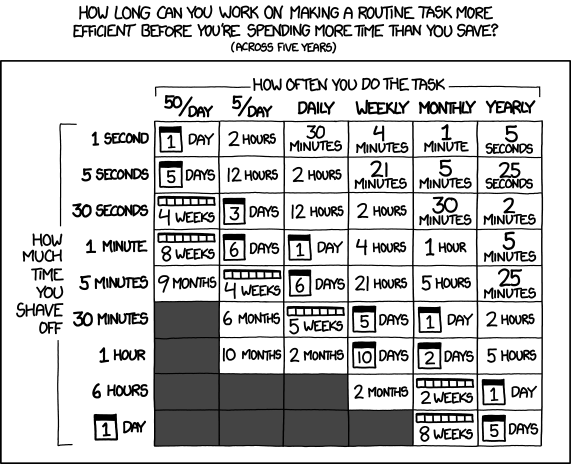 Source: xkcd #1205: Is It Worth the Time? by Randall Munroe.
An easy exercise
- Check your shell history for patterns that could be set to alias or bash scripts. Ask your agent to do this. With a halfway decent model, you may pick up a trick or two with
awk. - If you are missing some aliases, add them.
- If you are missing scripts for repetitive tasks, add them.
This is a good measure of your skill as well. If you find that AI isn’t able to complete even these most basic tasks, you are doing something wrong. You need to explore different/better models. Or you need to explore different prompting methods. I’m confident that any frontier model can implement simple toil tasks for you as long as you have started sufficiently small.
I did this and ended up adding several quality of life improvements within minutes. Then I moved on to more complex tasks. For example, I worked with my agent to build scripts to automate Jira ticket planning for the week as well as mid-week Jira reviews. It worked for me. I eventually turned them into skills I run straight from Claude Code.
With this approach, there is a compounding effect that leads to more productivity and less mental drag from toil. You will level up the complexity of the skills you’re focused on as your agents level up the complexity of the skills they are focused on.
Give it a try this week.